-scaled-1.png )

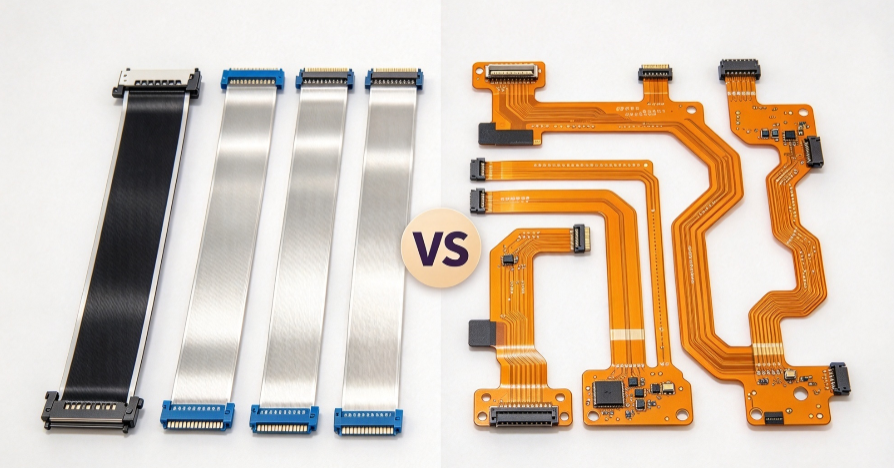
A common conversation we have with customers starts like this: “I need FPC.” A few questions later, it turns out an FFC would have done the job — and cost less.
The two are often confused because they look similar, both are flat, thin, and flexible. But they are fundamentally different products, built for different purposes. Choosing the wrong one either wastes money or causes reliability problems down the road.
Here is a simple way to think about it.
What Is FFC?
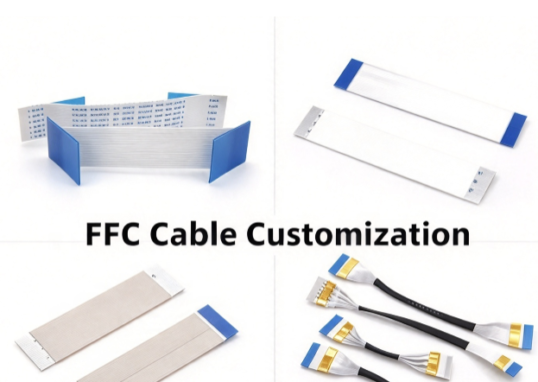
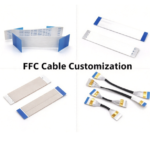
FFC stands for Flexible Flat Cable. It is a cable, made of flat copper conductors laminated between two layers of insulating film (usually PET). It transmits signals from point A to point B.
FFC is:
- Simple in structure — parallel conductors, no complex routing
- Cost-effective — lower tooling cost, faster production
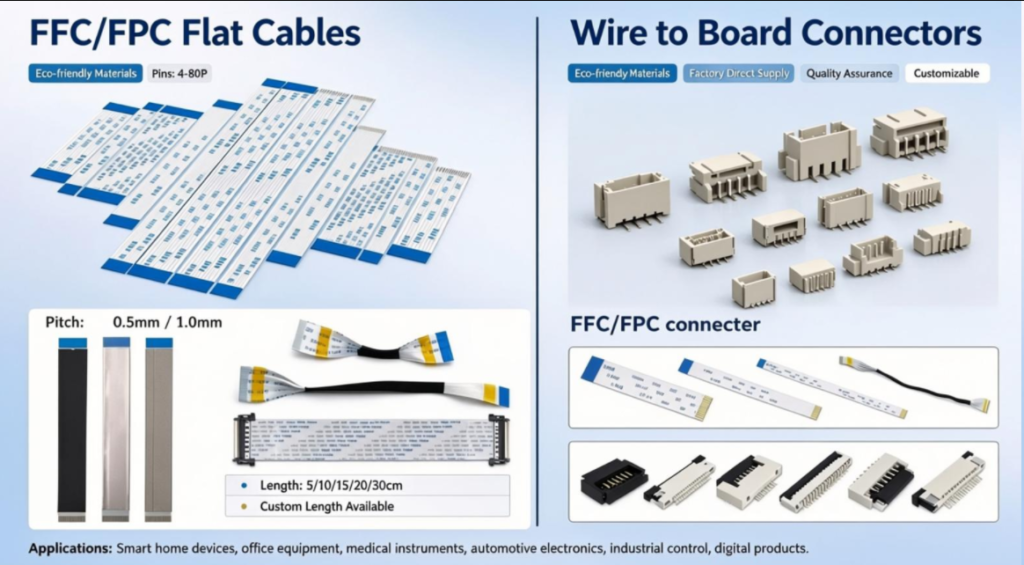
- Available in a wide range of pitches and pin counts — from 0.3mm to 2.54mm, 4 to 80+ pins
- Ideal for standard connections — display panels, printers, board-to-board signal links
FFC does not carry components. It does not have complex circuits. It is a connection solution. However, multy ways can make it adapter many different places for different usage, here is our intorduction of it:
What Is FPC?
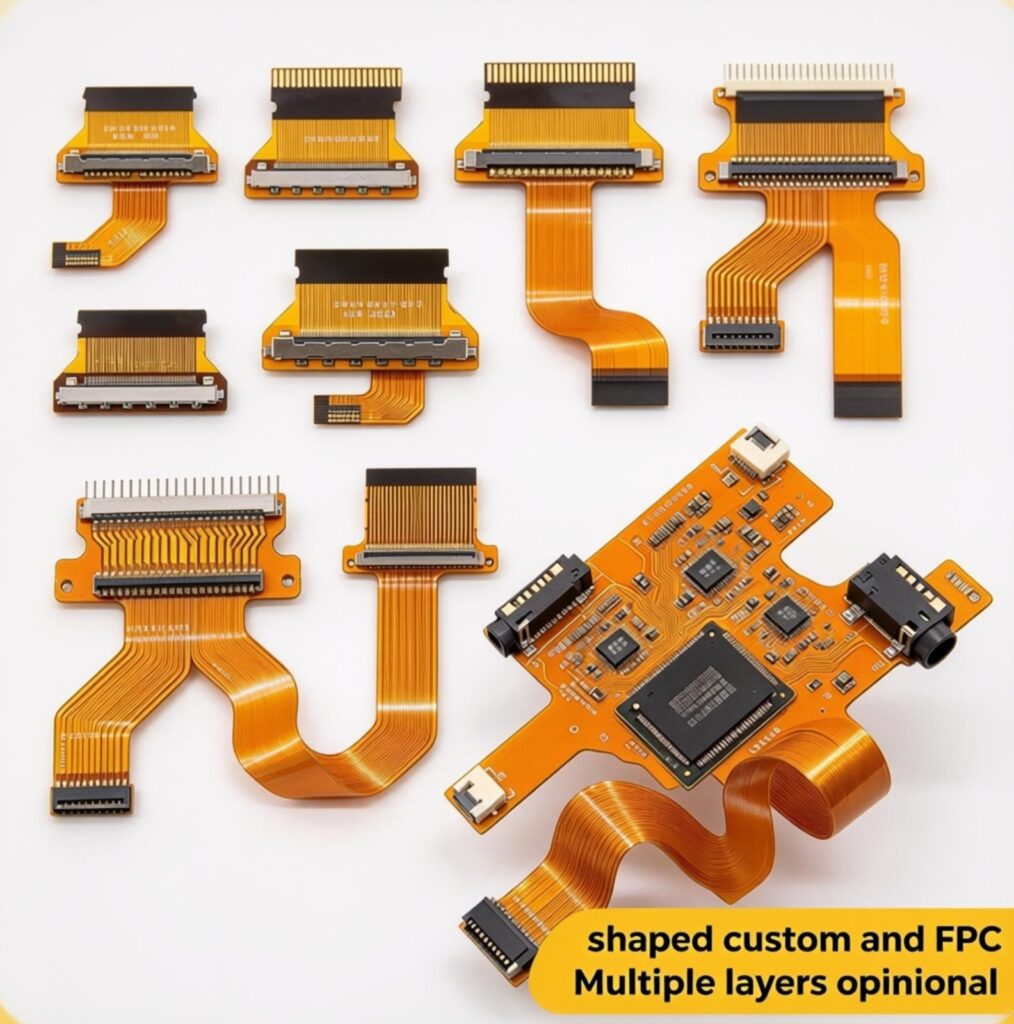
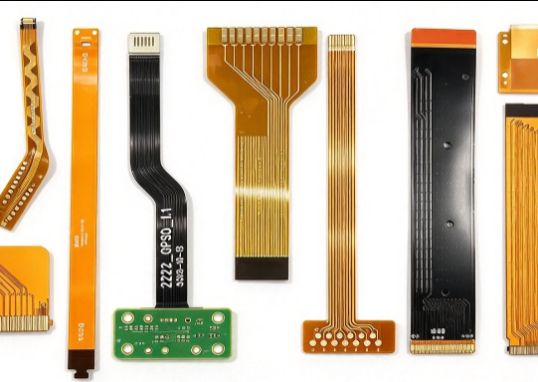
FPC stands for Flexible Printed Circuit. It is a circuit board, made by etching copper traces onto a flexible substrate (usually polyimide or PET). It can carry components, route complex circuits, and support multi-layer designs.
FPC is:
- More complex — can support single, double, or multi-layer circuits
- More flexible in design — any shape, any routing, 3D bends
- Able to carry components — resistors, capacitors, ICs, connectors can be mounted directly on the FPC
- Built for demanding applications — medical devices, drones, robotics, wearables
FPC is not just a connection. It is a functional circuit.
The Simple Decision Framework
| Your requirement | Recommended |
|---|---|
| Signal transmission only | FFC |
| Simple routing, cost-sensitive | FFC |
| Standard display connection | FFC |
| Component mounting needed | FPC |
| Complex routing required | FPC |
| High flex-life requirement | FPC |
| Extremely tight space, 3D routing | FPC |
| Multi-layer circuit | FPC |
Where the Cost Difference Comes From
FFC is cheaper because it is simpler to make. The conductors are pre-made, the lamination process is fast, and the tooling cost is low.
FPC requires etching, drilling, plating, and often component assembly. The tooling and production cost is higher — but it delivers capabilities FFC cannot match.
The mistake is not choosing FPC. The mistake is choosing FPC when FFC would have worked.
When Both Are Used Together
In many devices, FFC and FPC work side by side. For example:
- An FPC inside a camera module carries the image sensor and supporting components.
- An FFC connects that camera module to the main board.
The FPC handles the complex circuit. The FFC handles the connection. Both are necessary — but for different reasons.
The Bottom Line
FFC is a cable. FPC is a circuit.
If you only need to transmit a signal, FFC is almost always the better choice — cheaper, faster, and fully sufficient.
If you need to mount components, route complex circuits, or survive millions of flex cycles, FPC is the right tool.
If you are not sure which one fits your design, send us your drawing or describe your application. Our engineers can review it and recommend the right solution — FFC, FPC, or both.

Author

xl885479@gmail.com